


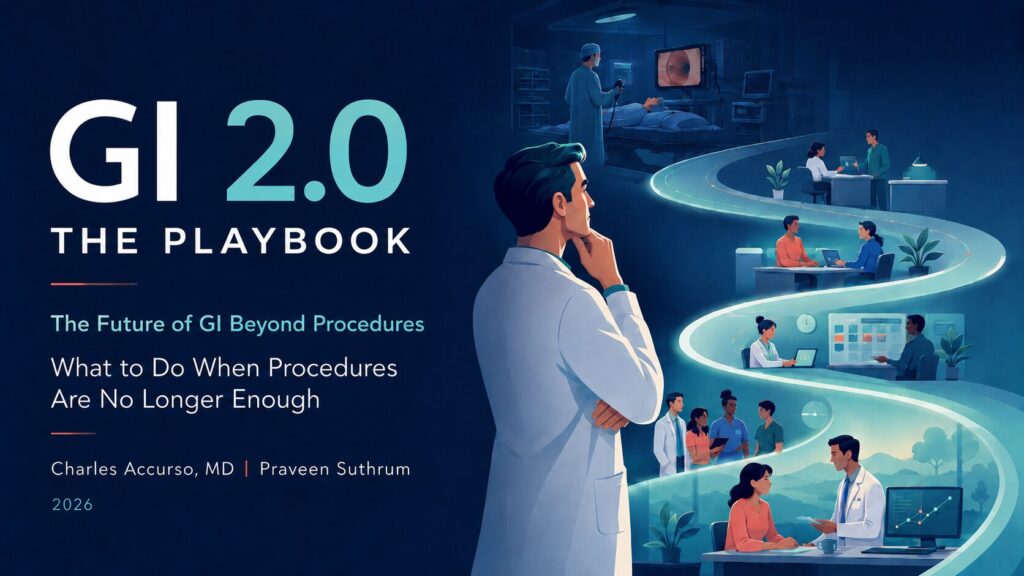
What Happens When Intelligence Becomes Part of the Infrastructure
By Dr. Charles Accurso and Praveen Suthrum
Imagine walking into a gastroenterology office several years from now.
Before the physician enters the first examination room, the relevant patient story has already been assembled. The system knows why the patient is there, what happened at previous visits, which tests were completed, what medications have changed, whether the current complaint resembles something that happened years earlier, and whether important items from prior care remain unresolved.
If the patient scheduled the visit because of right upper quadrant pain, much of the basic history may already have been collected. When did it begin? How severe is it? Is it related to meals? Does it radiate? Has the patient experienced something similar before? What laboratory testing, imaging, procedures, or diagnoses are relevant?
The gastroenterologist enters the room informed rather than searching.
The computer is no longer the dominant object in the encounter. Physician and patient can look at each other while ambient technology works in the background, organizing the conversation, preparing documentation, identifying follow-up items, and helping initiate whatever needs to happen next.
If an unfamiliar diagnosis enters the differential, current evidence can be retrieved during the conversation. If a medication is being considered, dosing information, contraindications, interactions, and relevant patient history can be surfaced without requiring the physician to interrupt the encounter and search through several different sources. The physician still interprets that information in the context of the individual patient, but no longer needs to depend entirely on memory or spend valuable time navigating disconnected systems.
When the encounter ends, the next set of actions can begin without another series of manual handoffs. Imaging orders can trigger the appropriate authorization workflow. Procedure scheduling can begin. Preparation instructions can be delivered and reinforced. A referring physician can receive the relevant update. If a follow-up appointment depends on a test being completed, the system can watch for that completion and intervene when something is missing rather than allowing the patient to arrive for a visit that cannot yet be useful.
The physician has not disappeared from this model. What begins to disappear is much of the machinery that has accumulated around the physician.
That is the starting point for the AI-native GI practice.
AI in GI Is Bigger Than the Procedure Room
For many gastroenterologists, artificial intelligence first became tangible through endoscopy. AI in GI became associated with computer vision, polyp detection, bounding boxes appearing on screens, and systems designed to improve recognition during colonoscopy.
That work remains important, but it represents only one part of what is developing.
AI in gastroenterology is beginning to operate across at least three broad domains.
The first is disease- and organ-specific clinical intelligence. AI can increasingly assist with image interpretation, disease classification, risk assessment, and clinical decision support across colorectal cancer, liver disease, inflammatory bowel disease, disorders of gut-brain interaction, upper GI disease, pancreatic disease, and other areas.
The second is deeper biological intelligence. Genomics, pathology, biomarkers, molecular diagnostics, microbiome data, and other increasingly granular biological information are generating datasets that are difficult for an individual clinician to synthesize unaided. AI may become increasingly useful in identifying which patterns matter and how they relate to diagnosis, prognosis, or treatment.
The third is the operating intelligence of the practice itself. This includes phones, referrals, scheduling, eligibility, prior authorization, documentation, recalls, coding, claims, denials, patient communication, and care coordination. These workflows consume enormous amounts of human effort today and are becoming increasingly amenable to intelligent automation.
Over time, these domains will begin to connect. The system that recognizes a change in a patient’s disease will increasingly communicate with the systems responsible for arranging care, contacting the patient, obtaining authorization, alerting the clinical team, and ensuring that the next step actually happens.
At that point, AI stops being a collection of applications and begins becoming part of the infrastructure of the practice.
AI-Enabled Is Not AI-Native
There is an important difference between an AI-enabled practice and an AI-native one.
An AI-enabled practice may use an ambient scribe, an AI phone agent, automated prior authorization, computer-assisted polyp detection, or revenue-cycle automation. Each technology may produce value, yet the underlying organization can remain largely unchanged. Staff may still move information manually from one system to another. One AI application may know nothing about what another has already done. Humans may continue supervising disconnected work queues and compensating for the lack of coordination among systems.
An AI-native practice begins from a different assumption: intelligence is continuously available across the organization.
That changes the design question. Instead of asking where AI can be inserted into the existing workflow, the practice asks how the workflow itself should be designed when software can listen, read, summarize, communicate, analyze, organize, and increasingly take action.
Once that assumption is made, many familiar processes begin to look unnecessarily manual. A referral should not have to sit in a fax queue waiting for someone to read it. A patient should not need to call during a narrow office window simply because that is when employees happen to answer telephones. A staff member should not have to remember to check whether an MRI was completed before tomorrow’s visit. A physician should not spend the first several minutes of every encounter reconstructing the patient’s history from multiple screens.
The purpose is not to remove people indiscriminately. It is to reconsider why human beings are performing each task and whether their attention is being used where it creates the most value.
The Patient Intelligence Layer
Healthcare still knows the patient primarily in episodes.
The patient appears for a visit. Information is collected. A decision is made. The patient leaves. Weeks or months may pass before the practice becomes aware of what happened next.
Disease does not behave that way.
Symptoms change between visits. Medications are started and stopped. Weight changes. Diet and activity change. New laboratory results appear. Another specialist orders imaging. A patient visits an emergency department. A screening test is completed, delayed, or never performed.
As we have said earlier in this book, the visit is an event, but the disease is continuous.
An AI-native practice begins to close that gap.
One way to think about this is through an evolving patient intelligence layer. The term digital twin is sometimes used, but it can imply a degree of biological fidelity that does not yet exist. A more practical concept is an increasingly complete digital representation of what is known about the patient.
That representation could combine medical history, laboratory results, imaging, procedures, pathology, medications, symptoms, risk factors, wearable information, home measurements, and relevant information from other clinicians as those sources become appropriately connected.
The important change is not simply that more information becomes available. The system can continually interpret what that information means for that particular patient.
Consider someone being followed for metabolic liver disease. Today, the GI practice may see that person periodically while changes in weight, metabolic markers, medications, activity, diet, or symptoms occur between visits with relatively little connection back to the practice. In a more continuous model, AI can follow relevant variables, provide routine education, identify missing information, reinforce the care plan, and recognize changes that may deserve human attention.
The physician does not need to watch every data point. The system watches the population and brings the appropriate patient back into human attention when needed.
Without that distinction, continuous monitoring would simply create continuous physician overload.
The Physician Intelligence Layer
There is a corresponding intelligence layer around the physician.
Experienced clinicians carry enormous amounts of implicit knowledge. They know which details matter when evaluating a particular symptom, which findings create concern, which patients need earlier follow-up, what information must be available before a procedure, and when a seemingly routine problem no longer feels routine.
Much of that knowledge resides within individual physicians.
An AI-native practice begins turning appropriate portions of it into shared organizational intelligence.
Clinical pathways, practice standards, escalation criteria, and physician preferences can increasingly be represented in systems that assist patients and staff within boundaries established by the practice. This is better thought of as physician-governed clinical AI than as an attempt to create a perfect digital copy of a doctor.
The point is not to reduce physician judgment to a protocol. It is to reduce the amount of scarce physician cognition consumed by routine repetition.
The physician becomes progressively more involved as uncertainty, complexity, risk, or consequence increases. Straightforward work can be automated more aggressively. Variable work can be managed by AI with human escalation. Clinically consequential work can be prepared by AI while the appropriate human makes the decision. In emotionally consequential situations, technology can support the encounter while the human relationship remains central.
The purpose of the intelligence layer is therefore not to reproduce the physician mechanically. It is to preserve physician attention for the situations in which judgment and human presence create the greatest value.
From Applications to Agents
Once these layers develop, it becomes natural to think of the practice not simply as a collection of departments but as a network of specialized intelligent agents.
A referral agent may receive incoming information, extract relevant data, identify missing elements, contact the patient, and begin scheduling. A scheduling agent can understand physician templates, urgency rules, procedure requirements, protected capacity, cancellations, and patient preferences. A prior-authorization agent can assemble documentation, understand payer requirements, monitor status, and escalate unusual cases.
The same logic can extend to revenue cycle, patient communication, compliance, documentation, and clinical preparation. A revenue-cycle agent may assist coding, submit claims, interpret payer responses, and identify unusual patterns for experienced human review. A clinical agent may assemble pre-visit summaries, longitudinal trends, unresolved issues, and relevant evidence before the physician enters the room.
The risk is obvious. Ten intelligent agents that cannot communicate simply reproduce today’s fragmentation using newer technology.
An AI-native practice therefore needs orchestration. If a patient calls because symptoms have worsened, the communication layer should understand enough about the patient and the relevant pathway to know whether the situation is routine, whether a clinician should become involved, whether an earlier appointment is required, and which other workflows need to begin.
The sophistication of an AI-native practice will not be determined by how many agents it purchases. It will be determined by how coherently intelligence moves through the patient journey.
The EHR Moves Into the Background
For decades, physician work has been organized around the EHR.
That was understandable when the EHR was one of the few reliable places to store and retrieve clinical information. Over time, systems designed largely as records were asked to become scheduling systems, billing platforms, communication tools, documentation systems, reporting engines, and workflow managers.
The consequences are familiar. Physicians look at screens instead of patients. Staff navigate layers of menus. Information may technically exist but remain difficult to retrieve. New technologies must work around systems that were not designed for continuous intelligent interaction.
The AI-native model changes that relationship.
The EHR does not necessarily disappear. For the foreseeable future, it remains an important system of record. What changes is the way humans interact with it. The physician asks a question and the relevant information is retrieved. The patient speaks and the information is organized. The clinician decides and the appropriate workflow proceeds.
The underlying software becomes less visible.
That makes openness strategically important. If the intelligence layer cannot reliably retrieve or write information because the underlying system restricts access, innovation slows. Interoperability therefore becomes part of the operating architecture rather than a technical aspiration discussed mainly by IT departments.
Do Not Rebuild the EHR Problem With AI
The next generation of technology could easily recreate the same problem in another form.
A practice may eventually use separate AI vendors for phones, referrals, documentation, scheduling, prior authorization, patient monitoring, and revenue cycle. If each company controls its own information and workflow logic, and every connection requires another proprietary integration, the organization will have created a new generation of silos.
The systems may be more intelligent, but the practice will still be fragmented.
Clinical pathways developed by physicians should therefore remain reconstructable and portable. Escalation rules should not disappear when a vendor relationship ends. Workflow logic should be documented. Important AI-mediated actions should be auditable. Clinical information should remain available through appropriately authorized mechanisms.
The principle is straightforward: the practice should be able to change the intelligence without rebuilding the practice.
This will eventually require broader industry standards. Professional societies, physicians, EHR companies, AI developers, health systems, payers, and other stakeholders will need clearer expectations around how intelligent systems exchange information.
Individual practices cannot solve that entire problem, but they can begin shaping the market by asking harder questions before choosing technology. What can the product do? How does it integrate? What information leaves the practice? What remains portable? What happens to the workflow if the relationship ends?
In an AI-native environment, openness becomes a strategic feature.
What We Can Already Learn From GI
The AI-native practice is still emerging, but several developments in gastroenterology already illustrate different parts of the architecture.
Iterative Health: When AI Disappears Into the Operating Model
Iterative Health shows how AI can become more valuable when it stops being treated as a standalone technology product.
The company began with a strong technology orientation in gastroenterology, including applications in endoscopy. As it evolved, it increasingly focused on a difficult operating problem: community clinical research. Recruiting appropriate patients into trials is labor-intensive, study criteria can be complicated, and research teams may spend large amounts of time screening patients who ultimately do not qualify.
Technology could help identify appropriate patients, but Iterative Health’s experience led it toward a broader operating model in which AI, research infrastructure, community physicians, and pharmaceutical sponsors could work together.
Its partnership with GI Alliance illustrates that shift. Rather than merely distributing another AI tool, the organizations set out to build infrastructure that could allow sophisticated clinical research to operate closer to where patients already receive care.
The lesson is larger than clinical trials. In an AI-native environment, the visible product may not be AI at all. The physician may simply experience a research program that works better, a referral process that closes more reliably, or an operating model that scales because intelligence has been embedded underneath it.
Virgo: When the Procedure Becomes a Data Asset
Virgo offers a different lesson.
Historically, an endoscopy has been treated primarily as a diagnostic or therapeutic event. The physician performs the procedure, documents the important findings, stores selected images, and moves to the next case. The complete video generated during the procedure has often had little life afterward.
Virgo began by changing that assumption through infrastructure designed to capture and store endoscopy video. Once a sufficiently large repository existed, the company developed EndoDINO, a foundation model specifically for endoscopy.
The significance extends beyond any single AI benchmark. Foundation models can potentially support multiple downstream applications rather than one narrowly defined task. Research around EndoDINO has included anatomical classification, polyp segmentation, ulcerative-colitis severity scoring, and exploration of predictive applications that could eventually contribute to precision medicine.
The implication for GI 2.0 is broader than Virgo itself. Practices should begin asking what information they generate today that may become more useful tomorrow. In an AI-native environment, data that once disappeared after the encounter may become useful for research, quality improvement, clinical trials, biomarker development, predictive models, or applications that do not yet exist.
The most important AI innovation may sometimes begin with the decision not to throw the data away.
OneGI: When AI Moves From Pilot to Production
A third example shows how the transition can occur inside an existing GI organization rather than a technology startup.
In work with OneGI, NextServices initially explored several AI-enabled workflows, including recalls and fax referrals. At the end of the pilot period, the teams chose to concentrate on the fax-referral workflow as the next area for deeper development and scale.
What emerged was not simply an AI tool that read a fax. The Fax Referral AI processes referrals from outside providers, extracts relevant information, applies workflow rules, contacts patients, and schedules appropriate appointments. By September 11, 2026, the system had scheduled 780 encounters within one participating OneGI practice, including 474 ASC visits, 297 office visits, and nine hospital visits.
Success with that workflow created confidence to address another major operational problem: inbound calls.
Rather than attempting to build every technical capability internally, NextServices partnered with NextDimension for voice AI. The joint deployment was completed rapidly, and the resulting agent—called “Sarah” by OneGI—began handling appointment scheduling, prescription-related requests, and general reception functions.
During a September 2026 dashboard period, Sarah handled thousands of calls and resolved roughly three quarters without requiring the human team to complete the interaction. Patients could ask to speak with a person directly, and the AI could also determine that a conversation needed escalation. Nearly all escalated calls were successfully connected to a human.
The workflow continues to evolve as real interactions reveal where the AI can safely take on more responsibility. A cancellation request that initially created a task for staff, for example, can now be completed directly by the AI when predefined conditions are met.
The importance of this case is not any single performance statistic. It is the progression from pilot to functioning workflow, from isolated automation to end-to-end execution, and from one successful use case to a broader operating layer. That is a realistic path for an established practice moving toward AI-native operations.
Forus and Squad Health: When the Practice Is Not the Economic Buyer
Medication access illustrates another part of the AI-native model: the organization using the capability does not always have to be the organization paying for it.
Obtaining specialty medications can require benefits investigation, prior authorization, appeals, pharmacy routing, financial-assistance programs, repeated payer communication, and ongoing patient follow-up. Much of that administrative work falls on physician practices even though several other organizations have major economic interests in whether the patient ultimately receives appropriate therapy.
Forus and Squad Health are building AI-supported infrastructure around these workflows while offering their services without charging participating physician practices directly. Forus has publicly described a model in which physicians and patients do not necessarily need to be the economic buyers of medication-access infrastructure. Squad Health similarly offers its medication-access platform to practices at no cost, although the specific commercial arrangements across such models can differ.
The idea is already relevant in GI. Forus has partnered with the AGA around medication access, while GI organizations including MNGI Digestive Health are using platforms such as Squad Health to reduce the administrative burden surrounding specialty therapies.
The broader lesson is important. The user of an AI capability, the beneficiary of that capability, and the organization paying for it do not always have to be the same entity.
Understanding that economic architecture will become increasingly important as GI practices assemble their future operating models.
Clinical AI Needs Clinical Governance
As intelligent systems become more capable, clinical governance becomes more important.
A practice should not deploy patient-facing or clinically meaningful AI simply because a vendor says that it works. Someone inside the organization needs to determine what the system is allowed to do, what requires human review, and where the boundaries lie.
In a smaller group, one physician champion may initially lead this work. A larger organization may benefit from a small physician-led AI or clinical innovation group. The purpose is not to create bureaucracy but to establish shared clinical ownership.
That group should understand the important use cases operating across the practice. It should know what the AI is allowed to communicate directly to patients, which actions it can initiate, what findings trigger escalation, which workflows are sufficiently low risk for greater autonomy, and which require clinical review. It should also establish a process for reviewing mistakes, near misses, patient complaints, workflow failures, and significant changes in the underlying technology.
Technical, compliance, security, operational, and legal expertise will all matter depending on the use case. Clinical governance, however, needs to remain connected to physicians who understand how care is actually delivered inside the practice.
The vendor supplies technology. The practice still defines how that technology participates in care.
Human Access Must Remain Easy
As AI moves from answering questions to taking actions, the ability to reach a human becomes increasingly important.
Patients should be able to reach a person when they need one—or simply when they want one. The purpose of AI is to expand access and reduce unnecessary friction, not to trap patients inside automation.
This becomes especially important when symptoms may be urgent, the patient is frightened, the AI does not appear to understand the situation, or the patient simply prefers human interaction.
The OneGI call-center experience reinforces this point. Many escalations occurred because patients themselves requested a human, while others were initiated by the AI. Both pathways matter. The patient needs an easy exit from automation, and the AI needs to recognize when it has reached the edge of its competence.
Staff also need override authority. Clinicians should be able to prevent an automated recommendation from becoming an action, and the organization should be able to suspend a system when its behavior appears unreliable.
Every meaningful automated pathway needs a safe failure mode. When data appears corrupted, an integration fails, or the clinical context becomes too complex, the workflow should move toward human review rather than continue blindly.
AI does not eliminate escalation. It makes escalation design more important.
Audit the AI, Not Just the Human
Healthcare organizations are accustomed to auditing clinicians and staff.
They can usually determine who entered an order, changed a record, billed a claim, or accessed a chart.
AI introduces another actor into that history.
The practice should therefore be able to reconstruct important AI-mediated events. What information did the system receive? What action did it take? What did it communicate to the patient? When did it escalate? Did a human override it? What happened afterward?
The objective is not to demand a perfect explanation of every mathematical operation occurring inside a modern model. The practical requirement is operational accountability.
When something important happens, the organization should understand enough about the event to investigate it, learn from it, and improve the system.
As AI becomes more deeply embedded in care, auditability will become as fundamental as documentation is today.
Patients Need to Understand the Relationship
AI-native care also changes the patient’s relationship with the practice.
Patients may increasingly have conversations with systems that feel natural. They may report symptoms late at night, discuss diet or bowel habits, admit that they stopped taking a medication, describe anxiety, or disclose information they might not remember during a hurried office visit.
That creates opportunity, but it also increases the importance of transparency and privacy.
Patients should understand when they are interacting with AI and how information from those interactions may be used. Practices should be thoughtful about which information is necessary, where it travels, who can access it, and how it is protected.
Continuous care depends on trust. A practice that handles patient information carelessly may undermine the willingness of patients to participate in the very systems that make longitudinal care possible.
The Workforce Does Not Simply Disappear
Whenever automation is discussed, the workforce question follows.
Some roles will change significantly. Some functions may require fewer employees. Practices may stop backfilling certain positions as AI becomes more capable. Work that previously required several people may eventually require one person supervising a largely automated process.
The more interesting possibility, however, is capability expansion.
GI practices already have more meaningful work than their teams can perform well. Patients wait for appointments. Calls go unanswered during peak periods. Referral follow-up is inconsistent. Care coordination is incomplete. Longitudinal outreach is difficult to sustain. Physicians do not have enough time for proactive communication.
There is no shortage of useful work. Too much human capacity is simply consumed by transactions.
If AI releases staff from repetitive precertification, scheduling, data entry, document movement, and routine phone calls, some of those employees can move toward patient-facing roles. They may become navigators, disease-program coordinators, referral coordinators, escalation managers, or longitudinal outreach staff. Others may supervise groups of intelligent agents or become workflow and implementation specialists.
The unit of productivity may gradually change as well. Instead of measuring how many individual tasks one employee completes, the practice may increasingly measure how many patients or workflows a human-AI team can manage safely and effectively.
That is not merely a smaller workforce doing the same work. It is a differently designed workforce doing different work.
Physicians Are Part of the Workforce Transformation
The same logic applies to clinicians.
Gastroenterology has limited specialist capacity, and not every patient requires the full expertise of a gastroenterologist at every stage of care. APPs already play important roles in many practices. Increasingly capable AI support may allow appropriately trained nurse practitioners and physician assistants to manage larger portions of routine and protocol-driven care while gastroenterologists concentrate more heavily on complex diagnosis, procedures, advanced disease, difficult decisions, and cases that exceed standard pathways.
Within the physician’s own day, the effect may be equally important. If AI prepares the chart, organizes the history, drafts documentation, tracks missing tests, supports routine communication, and reduces administrative work around an encounter, physicians gain capacity.
Some of that capacity will appropriately be used to improve access and see more patients. But not every minute saved should automatically become another appointment.
Technology can also restore something medicine has steadily lost: the time required to think carefully about difficult cases, listen without simultaneously documenting, participate in discovery, and remain present during moments that require human attention.
The opportunity is not simply to make physicians faster. It is to make scarce physician attention more valuable.
Becoming More Human
The phrase AI-native practice can sound impersonal, as though the future clinic will be defined by machines while clinicians recede into the background.
That should not be the goal.
Medicine became transactional long before generative AI arrived. Physicians stare at screens. Front-desk employees answer phones while patients stand in front of them. Nurses work through repetitive forms. Billing teams spend hours navigating payer systems. Clinicians rush through visits because documentation continues afterward.
Much of the loss of human connection came from the operating model itself.
AI creates an opportunity to redesign that model.
A front-desk employee can pay attention to the elderly patient who has just arrived rather than answering another routine call. A physician can listen rather than type. A care coordinator can contact the patient whose condition is worsening instead of manually checking a work queue. The practice can identify someone who needs attention before the next scheduled visit rather than after an emergency has already occurred.
The right use of AI is not simply to make healthcare faster. It is to move human attention toward the parts of medicine where human presence matters most.
Do Not Start With a Large AI Transformation Budget
Everything described so far can sound expensive.
A physician partnership hearing about AI agents, patient intelligence layers, clinical governance, interoperability, and continuous care may reasonably ask who is going to pay for the transformation.
That question cannot be dismissed.
Most physician-owned GI practices do not operate like technology companies with large speculative research budgets. Partners depend directly on practice economics, and substantial investments eventually need to create measurable value.
The migration should therefore usually begin with a painful operational problem rather than a large AI strategy.
A practice might identify a referral backlog that is causing patients to be lost before scheduling, an overwhelmed phone system, incomplete recalls, excessive prior-authorization work, slow denial follow-up, or the need to keep adding staff simply to manage repetitive activity.
These are useful starting points because results can be observed. Did more referrals become appointments? Were calls answered more reliably? Did access improve? Was staff capacity released? Did collections increase? Was another hire avoided?
Once physicians see that an intelligent workflow can produce meaningful operational or economic value, the conversation changes. AI has earned permission to expand.
Stage One: Prove It
The first stage should be narrow.
Choose a workflow that is painful, repetitive, high-volume, and measurable. Ideally, begin outside the highest-risk clinical domain while the organization learns how to deploy AI safely.
The first project is important not only because of its potential financial return. It also teaches the practice how AI implementation actually works.
Leadership learns how vendors behave, how staff respond, where workflows break, what integration is necessary, how exceptions appear, and how much human supervision remains necessary. The organization also discovers whether someone truly owns the project, whether meetings happen, whether staff adapt, and whether every imperfection becomes a reason to stop.
The technology is being tested, but so is the organization.
Stage Two: Automate the Workflow, Not the Task
The next stage begins when the practice realizes that automating one isolated activity does not necessarily solve the underlying problem.
An automated phone call may save time, but if a staff member still has to interpret the result, enter information manually, search for an appointment, call again, and update several systems, the practice has automated only a fragment.
The larger opportunity comes from end-to-end redesign.
A referral workflow begins when information enters the practice and ends when the appropriate patient reaches the appropriate clinician or procedure with the necessary information available. Everything between those points should be examined.
Where does the referral arrive? What information needs to be extracted? What is missing? Who contacts the patient? How is urgency determined? How is the appointment selected? What authorization is required? How does the referring clinician know what happened?
Once the practice begins thinking this way, AI stops being a feature attached to one step and becomes part of workflow architecture.
Stage Three: Connect the Intelligence
The third stage is where the practice begins becoming genuinely AI-native.
The referral system understands scheduling. Scheduling understands the clinical pathway. The clinical pathway understands what testing remains incomplete. The patient-facing system knows when to remind, educate, or escalate. The revenue-cycle system knows which clinical information is needed for authorization.
The physician begins seeing one coherent patient story rather than the outputs of several disconnected tools.
At this stage, the organization can move beyond administrative efficiency toward more continuous clinical intelligence. The same infrastructure that notices an MRI has not been completed may eventually identify that a liver patient’s condition is changing. The system that reminds a patient about bowel preparation may later support a longitudinal disease pathway.
The migration is therefore incremental. Prove AI first on manageable work, build organizational confidence, connect workflows, and then move progressively closer to the clinical journey.
Who Pays for Continuous Care?
Operational automation can often generate a relatively direct economic return.
Longitudinal care is more complicated.
If a GI practice begins following patients continuously, intervening earlier, preventing avoidable emergency visits, coordinating care between encounters, and managing populations rather than isolated visits, the value created may not fit neatly inside traditional fee-for-service economics.
Consider an IBS patient who has historically visited the emergency department repeatedly. Suppose a longitudinal program allows the patient to communicate earlier, receive ongoing support, and trigger clinical attention before symptoms become severe enough to prompt another emergency visit.
If emergency utilization falls, several parties benefit. The patient experiences less disruption. The payer potentially spends less. The healthcare system avoids unnecessary expense. The GI practice, however, has performed meaningful work that may not correspond to a conventional office visit.
AI can make longitudinal care technically possible. The payment model determines whether practices can sustain it.
Pay for the Outcome, Not the AI
Payers should not reimburse a GI practice simply because it uses artificial intelligence.
They should pay for value.
Traditional fee-for-service will likely remain important for procedures, visits, and other services. Alongside it, practices may increasingly participate in per-member-per-month arrangements, disease-specific bundles, quality incentives, employer contracts, shared-savings structures, or other value-based models.
Different disease pathways may require different approaches. IBD does not behave like colorectal cancer screening. Fatty liver does not behave like routine dyspepsia. Some pathways have measurable effects on hospital or emergency utilization, while others create value through earlier diagnosis, improved adherence, better access, or slower disease progression.
There may never be one GI 2.0 reimbursement model.
The more important principle is alignment. If a practice invests resources in preventing expensive downstream events and succeeds, the economic structure should allow it to participate in some of the value created.
Real-Time Data Changes Value-Based Care
Healthcare has discussed value-based care for years, but one persistent limitation has been the timing of information.
It is difficult to manage a population proactively when meaningful data arrives weeks or months later. Knowing retrospectively that a patient visited an emergency department may help with reporting, but it does not help prevent the visit.
An AI-native infrastructure changes what becomes possible.
A patient enrolled in a longitudinal program may report worsening symptoms during the evening. The system can recognize the pattern, ask appropriate follow-up questions within defined boundaries, and escalate when necessary. In another scenario, the practice could receive sufficiently timely information that one of its managed patients has entered an emergency department and become involved while decisions still matter.
As information becomes more immediate, value-based care can move from retrospective analysis toward real-time operations.
That transition may ultimately matter more than any individual AI application.
The Payer Can Set the Goal Without Choosing the Technology
Payment can also accelerate intelligent care without requiring payers to dictate specific technologies.
A payer can define the outcome it values and allow practices reasonable freedom in deciding how best to achieve it.
If expectations rise around screening quality, disease control, patient access, care gaps, or avoidable utilization, practices will naturally adopt technologies that help them meet those expectations efficiently.
This is more durable than paying for the acquisition of a particular AI product. Technologies will change rapidly. The desired outcome should remain relatively stable.
The payer can define the destination without specifying every tool used to reach it.
The Frontier Will Keep Moving
The architecture described in this chapter will not stop with software.
Robotics, sensors, remote monitoring, non-invasive diagnostics, molecular testing, virtual care, and new procedural technologies will continue evolving. Future surgery centers may use robots for selected logistical or support functions. Home devices may contribute information continuously. Virtual interactions may become more sophisticated. Routine procedures may generate increasingly rich data for predictive models.
Some of these technologies will mature rapidly; others will take longer than enthusiasts expect.
The practice does not need to predict exactly which technology will dominate five years from now. It needs an architecture capable of absorbing useful innovation without rebuilding itself every time something new appears.
Information therefore needs to move safely across systems, interoperability must become part of the underlying infrastructure, and clinical governance must evolve alongside technological capability. The practice does not need perfect foresight. It needs enough flexibility to use what ultimately proves valuable.
What the Practice Must Refuse to Surrender
As the intelligence layer becomes more important, several principles should become non-negotiable.
Practices need durable access to their clinical information and the ability to move that information appropriately across authorized systems. Physician-developed pathways, escalation rules, and workflow logic should not become irretrievably trapped inside one vendor. Important AI-mediated actions should be auditable, while humans retain meaningful control over clinically important workflows.
Clinical responsibility must remain clearly assigned. Introducing AI does not remove the need to understand who remains accountable for important decisions. Patients should receive appropriate transparency regarding the use of AI, while privacy and security need to be built into the architecture from the beginning.
The practice should also preserve the ability to change technology partners without losing the organizational intelligence it has helped create.
Perhaps most importantly, physicians need enough AI literacy to govern these systems intelligently. As the technology becomes more capable, physician disengagement becomes more dangerous, not less.
Intelligence Should Recede Into the Background
The most successful AI-native practice may eventually be the one in which patients and physicians think about AI the least.
Today, technology continually calls attention to itself. Physicians and staff log in, open windows, re-enter information, wait for systems to respond, navigate work queues, and communicate across departments simply to complete routine tasks. Much of the friction of modern healthcare comes not from the clinical complexity of the patient but from navigating the systems surrounding the patient.
In an AI-native practice, that technology should increasingly recede into the background. A patient calls and receives help without needing to know which department owns the problem. A physician enters the room with the relevant history already assembled. When a test is ordered, the necessary administrative steps begin without another sequence of manual handoffs. Referring physicians receive the information that matters, missing tests trigger follow-up, claims move through the revenue cycle, and exceptions surface to the appropriate person.
Neither the patient nor the physician needs to know how many intelligent systems made those actions possible.
What matters is that the system works reliably and that a human can intervene whenever one is needed.
What Do Humans Do When Intelligence Becomes Abundant?
This may ultimately become the most consequential question.
Suppose administrative work is compressed dramatically. Routine knowledge retrieval becomes nearly instantaneous. Clinical information organizes itself. Ordinary coordination is increasingly automated, and AI becomes capable of managing more predictable work.
What should gastroenterologists do with the capacity that remains?
One answer is obvious: see more patients. Some of that will happen, and improving access is a legitimate goal in a specialty with limited physician supply.
But it cannot be the entire answer.
Digestive health still contains enormous areas of uncertainty. Connections among metabolism, the microbiome, the nervous system, inflammation, cancer, behavior, environment, and the GI tract remain only partly understood. There are disease pathways that medicine has barely begun to explore.
AI can give physicians tools to investigate those questions more deeply. It can make sophisticated analysis available outside major research institutions, identify patterns across populations that no individual clinician could hold in memory, make proactive medicine more feasible, and extend specialist expertise to patients who currently struggle to access it.
Technology can also return something medicine has steadily lost: time. Physicians may gain more room to think carefully about difficult cases, listen without simultaneously documenting, participate in discovery, and remain present during moments that require human attention. Some of the capacity created by AI will be used to improve productivity and access, but the larger opportunity is to redirect scarce physician attention toward work that is intellectually, clinically, and relationally more valuable.
The ultimate measure of an AI-native GI practice should therefore not be the number of agents it deploys, the amount of labor it eliminates, or the sophistication of its software. It should be what the practice becomes capable of doing for patients that it could not do before.
Intelligence as Infrastructure
The transition from GI 1.0 to GI 2.0 is not a transition from humans to machines. It is a transition from a practice organized around scarce human attention to one in which many forms of intelligence are continuously available.
As administrative intelligence becomes easier to access, staff can spend less time on repetitive coordination. As clinical information becomes continuously organized, physicians spend less time reconstructing the patient’s story. As routine communication becomes automated, human attention becomes available for situations that require judgment, trust, empathy, or reassurance. When workflows can monitor themselves, the practice can identify gaps earlier and intervene before patients disappear between visits.
The promise of the AI-native GI practice is therefore not that AI will do everything. It is that the work of the practice can be redesigned around a fundamentally different allocation of intelligence.
The transition will not occur all at once, nor should it. The first project may involve a fax queue, phone line, recall list, or referral workflow. The next may connect several tasks into an end-to-end process. Over time, those workflows begin communicating and intelligence moves progressively closer to the clinical journey.
Practices do not need to wait until every technology described in this chapter has matured. They need to build the organizational capacity to absorb what is already useful and what becomes useful next.
That brings us to the practical question facing every reader of this book.
How does a GI practice take what it already has—its physicians, staff, patients, EHR, contracts, procedures, limitations, and strengths—and begin moving toward GI 2.0 without trying to change everything at once?
The answer requires sequence.
The next chapter is the 12-month playbook.