


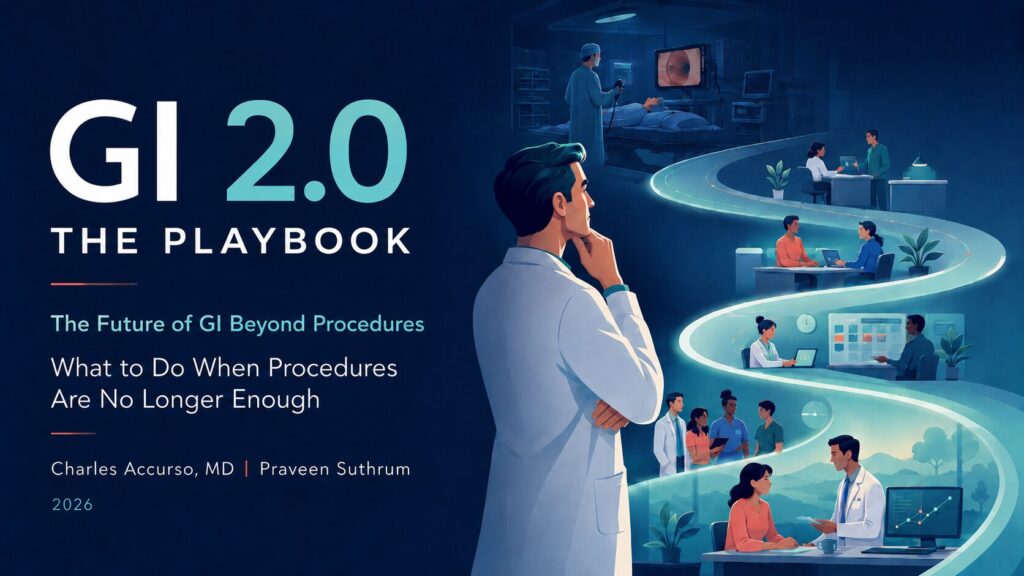
Following the release of Chapter 1 of GI 2.0: The Playbook, several gastroenterology leaders shared thoughtful reactions on the future of procedures, AI, value-based care, and the evolving role of GI practices.
Interestingly, many of the themes emerging today — including care delivery transformation, technology adoption, and evolving GI practice models — were already being discussed nearly two decades ago in an AGA Institute Future Trends Report published in 2006. What feels new today may actually represent the acceleration of longer-term structural shifts within gastroenterology.
While perspectives differed, several common themes emerged repeatedly:
- GI has historically adapted well to change.
- Colonoscopy demand may remain more durable than many projections suggest.
- The larger transformation may be operational and economic rather than purely procedural.
- AI’s earliest impact in GI may come through workflow and efficiency.
- GI practices may need to expand beyond procedure-centric models into broader digestive health ownership.
The insights below are drawn from private written responses shared following the release of GI 2.0: The Playbook. Excerpts have been edited and condensed for clarity and publication purposes while preserving the original viewpoints.
GI Has Historically Adapted Well to Change
Several physicians argued that gastroenterology has historically been one of medicine’s more innovative specialties.
“We went from doing all of our procedures in a hospital inpatient department with one assistant, to building outpatient endoscopy centers, to hiring our own anesthesiologists, to building large anatomic pathology laboratories.”
“At the practice setting, we built large infusion centers and video capsule capabilities. Constantly innovating.”
Another physician noted:
“Without a change in thought and how GI docs do things, we will have lost a great opportunity to get back what we once dominated.”
Several responses also raised concerns around the growing amount of non-reimbursed cognitive and coordination work in GI.
“All the things we do that are not directly reimbursed I am afraid will slowly fade away and further fracture care.”
Colonoscopy Demand May Be More Durable Than Expected
Several leaders pushed back on the idea that GI is approaching a truly “post-procedure” future.
One respondent pointed toward persistently low screening penetration:
“Only two-thirds of patients in the US over the age of 50 have had recommended colon cancer screening of any kind.”
“Less than one-third of patients over 45 have completed recommended screening of any kind.”
Another physician argued that even if non-invasive testing improves, procedural demand may decline more slowly than many expect:
“A universal stool DNA/RNA-first strategy for average-risk screening would dramatically reduce colonoscopy volume in any single screening cycle, but the lifetime reduction is substantially smaller because of cumulative false positives, surveillance colonoscopies, and diagnostic demand.”
Several responses also highlighted large under-screened opportunities in upper GI disease.
“The data suggest that if physicians strictly followed current Barrett’s esophagus screening guidelines, EGD volume would increase by millions of procedures annually.”
“Only 39% of screening-eligible patients have undergone EGD in primary care settings, and the gap between guideline recommendations and actual practice is enormous.”
One contributor summarized the larger concern this way:
“The issue may not be fewer procedures. The issue may be defining GI too narrowly around procedures.”
The Bigger Shift May Be Operational and Economic
Multiple responses suggested that the larger transformation in GI may be driven less by procedural elimination and more by workflow redesign, reimbursement evolution, and operational efficiency.
One physician observed:
“Doctors are cautious, especially when things are going well.”
The same response added:
“They generally wait for the train to run them over before jumping off the tracks.”
Several physicians believed AI adoption is likely to expand first in areas such as:
- ambient documentation,
- data management,
- workflow coordination,
- revenue cycle operations,
- call center automation,
- patient communication.
As one respondent described it:
“Data management, automated document filing, call center, revenue cycling, ambient patient interaction.”
Others emphasized that future opportunities may emerge through new payment and care delivery models.
“Colon cancer prevention works so much better and provides great value with a stable workforce.”
“There is a better way with ensuring some compensation, using new technology and tools to help efficiencies and so on.”
Several responses also pointed toward future expansion opportunities in:
- value-based care,
- direct-to-employer arrangements,
- metabolic disease management,
- microbiome medicine,
- longitudinal IBS and IBD care,
- preventive digestive health.
Taken together, the responses suggest that the future of gastroenterology may be less about procedural disappearance and more about whether GI practices expand their role beyond procedures into broader digestive health ownership.
1 Comment
Pingback: GI 2.0: The Playbook | Chapter 5 | The Foundational Layer - Scope Forward