

The microbiome has become one of the biggest battlegrounds in modern medicine.
Its promise is enormous: earlier disease detection, personalized nutrition, prevention-first care, and a deeper understanding of human biology. Yet many gastroenterologists still face colorful microbiome reports with unclear clinical utility and few actionable answers.
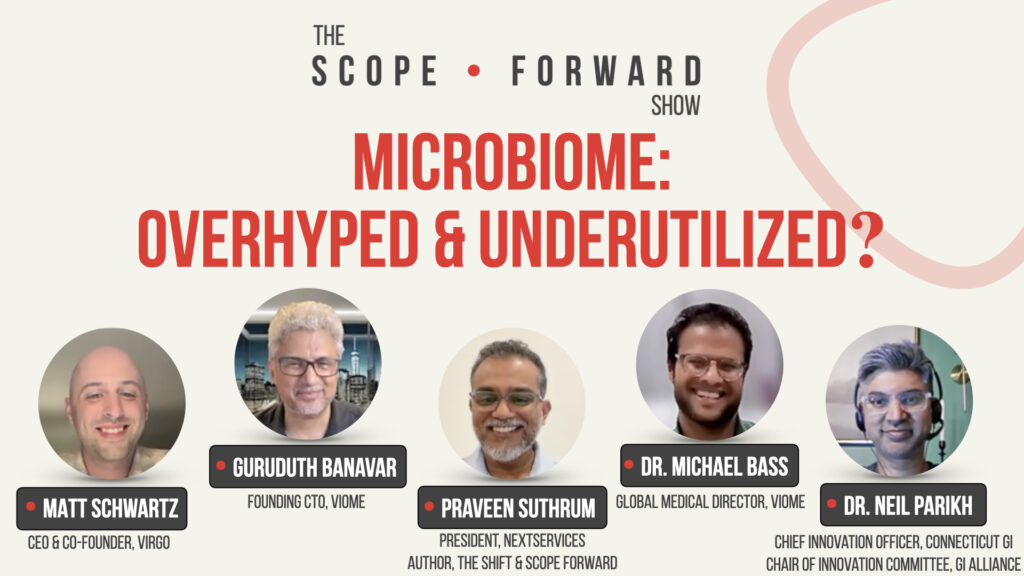
Guruduth Banavar, Founding CTO & Head of Discovery AI, Viome and Dr. Michael Bass, Global Medical Director, Viome, joined me and co-hosts Dr. Neil Parikh (CIO, Connecticut GI and Chair of Innovation, GI Alliance), and Matt Schwartz (Founder and CEO of Virgo).
We explored why clinicians remain skeptical of microbiome testing, how metatranscriptomics differs from traditional approaches, and what happens when biology becomes measurable long before disease becomes visible.
1. “The microbiome is overhyped and underutilized.”
Dr. Parikh argues that microbiome science holds enormous promise, yet most gastroenterologists still lack actionable ways to use microbiome data in patient care.
2. Most microbiome science may be built on outdated technology.
Guru explains why the vast majority of microbiome research still relies on 16S sequencing and why newer approaches such as metatranscriptomics may offer a more clinically meaningful picture.
3. The field may be measuring the wrong thing.
Traditional microbiome testing focuses on which organisms are present. Metatranscriptomics focuses on what those organisms are actually doing inside the gut.
4. GI may already be behind on microbiome medicine. Can the industry leapfrog?
Dr. Bass argues that many clinicians were never taught the evolution from 16S sequencing to metatranscriptomics, creating a widening gap between research and clinical practice.
5. Longevity clinics may move faster than traditional GI practices.
Dr. Parikh points to longevity medicine and direct primary care as areas already embracing microbiome-driven personalization while much of gastroenterology remains cautious.
6. Can microbiome-guided nutrition improve IBS outcomes?
Guru shares data from a placebo-controlled study and discusses how microbiome-based approaches could move IBS management beyond today’s trial-and-error treatment model.
7. Molecular biology is becoming an AI problem.
Guru explains how Viome’s AI analyzes molecular data rather than text or images, translating millions of nucleotide reads into biological pathways and personalized recommendations.
8. The next AI breakthrough in GI may come from convergence.
Matt Schwartz describes a future where endoscopic AI, metatranscriptomics, and histopathology combine to create entirely new disease models and phenotypes.
9. “If I’m finding colon cancer, we’ve already missed the boat.”
Dr. Parikh argues that the greatest opportunity is not detecting cancer earlier, but identifying the biological dysfunctions that precede cancer formation altogether.
10. Will microbiome testing become part of routine GI care?
The panel discusses the workflow, reimbursement, and adoption challenges that will determine whether microbiome testing becomes mainstream by 2030.
Watch the episode.