


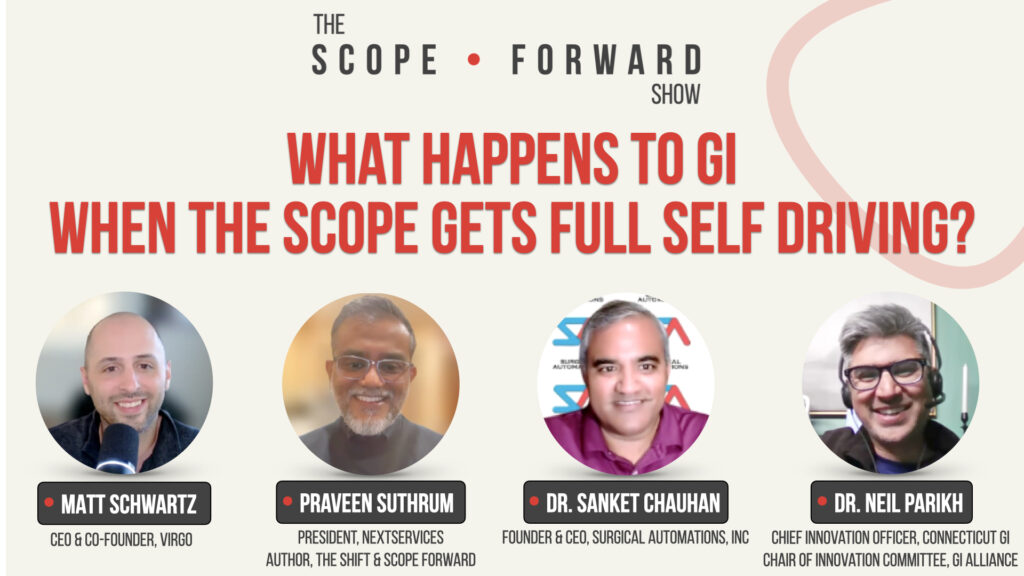
Dr. Sanket Chauhan, Founder & CEO of Surgical Automations, joined me and co-hosts Dr. Neil Parikh (CIO, Connecticut GI and Chair of Innovation, GI Alliance) and Matt Schwartz(Founder and CEO of Virgo) — and opened the conversation by showing us footage none of us were fully prepared for.
Inside a pig’s intestine, a 15mm robot identifies the lumen, reads the walls, and advances — autonomously. No hands on the scope. No physician guiding the tip. Just hardware and software in a closed loop, doing what takes most fellows years to develop feel for.
This is ex vivo work. A pig model in a lab. But the engineering underneath it is already heading into large animal studies, with first-in-human trials projected by end of 2025 and a market entry target of 2029–2030.
“Think of it as the world’s smallest Tesla — full self-driving, 15 millimeter diameter.”
— Sanket Chauhan
What surprised us wasn’t the engineering. It was the conversation that followed.
1. Building “the smallest Tesla in the world”
Surgical Automations is building automated colonoscopy where the gastroenterologist is “more a supervisor,” with a 15 millimeter diameter robotic platform.
2.Evidence-based medicine before full automation
Sanket pushes back on jumping to fully automated colonoscopy: “We are not in the business of technology. We are in the business of evidence based medicine.”
3. Non-invasive screening will flood GI with therapeutic demand/Non-invasive screening won’t shrink GI — it will flood it
Neil sees a surge ahead: “we’re going to have a higher demand, I really believe for therapeutic colonoscopy which we currently don’t have the bandwidth to support in most places across the country.”
4.Objective quality metrics become possible
The robot can generate “objective number of withdrawal time,” ADR and throughput metrics — measured the same way across Connecticut, Texas, California or 40 clinics.
5. “Our health system is craving fully automated endoscopy”
Matt’s payer-incentive read on the endgame: the system is structurally pulling toward “automated, fully automated, ideally no human labor, endoscopy just like we see with the full self-driving car.”
6. Why automating the colon is harder than automating the brain
Pushing back on Elon’s three-year surgery timeline, Sanket notes the colon moves — “imagine driving and setting a GPS, but your road changes as you are” — unlike fixed neurosurgical anatomy.
7. This isn’t master-slave robotics — it’s true automation
Sanket says this is “the first robot of its sign that is not a master slave relationship” — the AI identifies the anatomy and the robot drives itself
8. The episode ends with a thought experiment
What does a gastroenterologist’s day look like in 2035? Three different answers. None of them comfortable. All of them worth thinking about before someone else does it for you.
This was one of the most candid conversations we’ve had on the show. Sanket doesn’t perform startup optimism. He thinks in evidence, timelines, and edge cases, which made the moments where even he said “we’ll get there” land differently.
Watch the episode.