

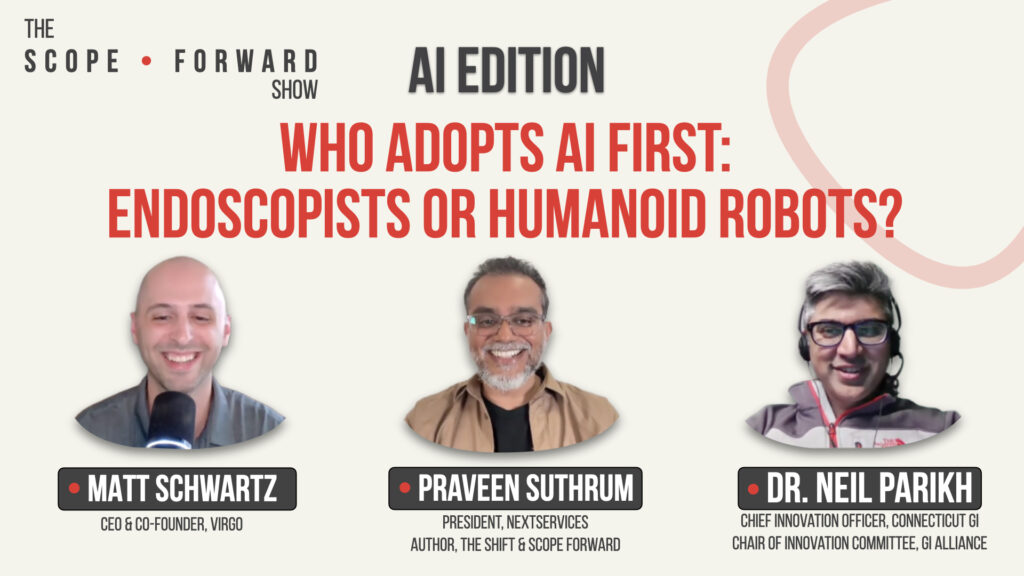
In the latest edition of The Scope Forward Show, I’m joined by:
Matt Schwartz, Founder & CEO of Virgo
Dr. Neil Parikh, Chief Innovation Officer, Connecticut GI and Chair of Innovation, GI Alliance
AI is moving from theory to real infrastructure in healthcare. In this episode of the Scope Forward Show, we explored what happens when Big Tech, AI agents, robotics, genomics, and data platforms converge—and what it means for gastroenterology.
The conversation ranged from Amazon’s new health AI agent to AI-assisted colonoscopy, humanoid robots, and even space-based data centers powering the next wave of AI.
Watch the episode.
Top Insights from the Interview:
- Big Tech is becoming the new front door to healthcare
Companies like Amazon and Microsoft are building AI health agents that could become the first point of contact for millions of patients.
- The real business opportunity may be healthcare data
At scale, aggregated health data could become more financially valuable than patient visits themselves.
- Virtual GI platforms may become acquisition targets
If AI-driven healthcare platforms expand, companies delivering virtual GI care could become strategic assets for Big Tech.
- AI may shift doctors from operators to supervisors
As AI systems assist with diagnosis and procedures, physicians may increasingly oversee intelligent systems rather than perform every step themselves. - Training the next generation of gastroenterologists may need to change
If fellows rely on AI too early, the field must rethink how fundamental skills are taught before AI assistance. - The real question is adoption speed
Whether AI transforms GI depends less on the technology itself and more on how quickly the field adopts tools like computer-aided detection. - Humanoid robotics and automation are moving faster than expected
Robots capable of performing complex tasks could eventually intersect with AI-guided medical procedures. - AI tools could enable biomedical innovation outside traditional labs
With tools like AlphaFold and AI research assistants, small teams—even non-clinicians—may increasingly explore new therapies. - The future GI stack may combine endoscopy, AI, and molecular data
The most powerful clinical insights may emerge from integrating imaging, genomics, and microbiome data in real time.